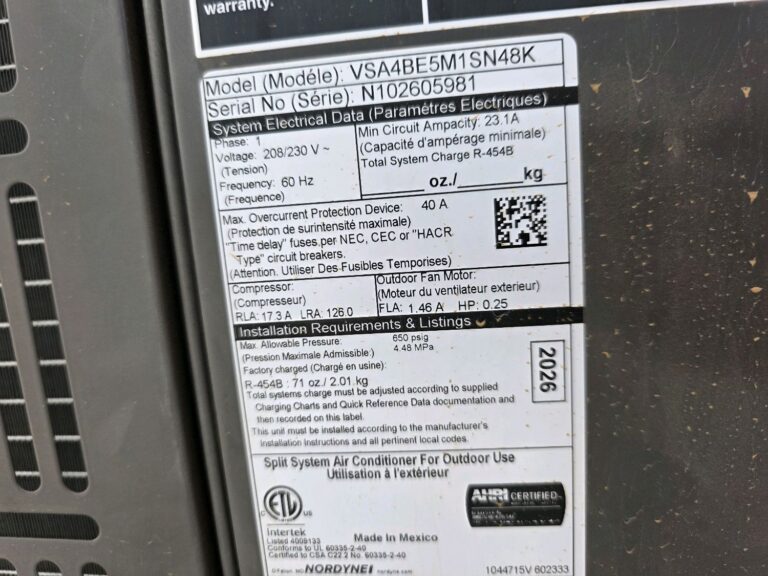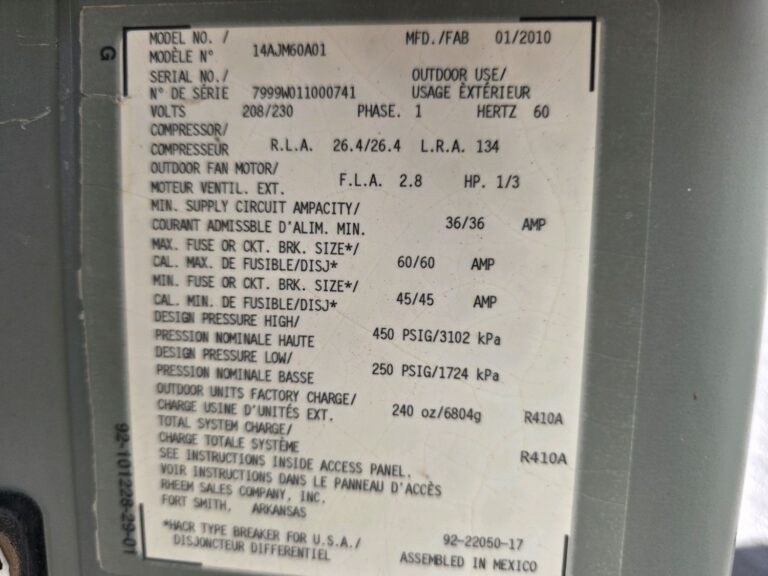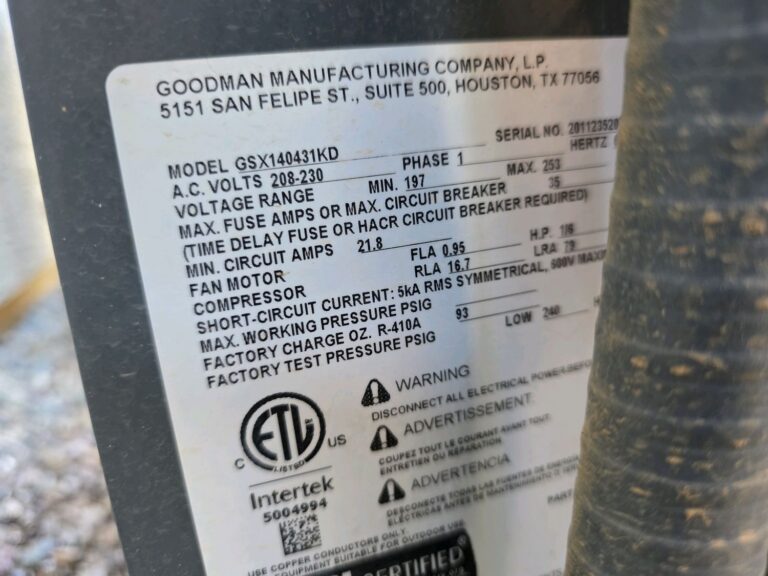
York, Coleman, Luxaire, Guardian and Champion air conditioners and furnaces all come from the same company, and since 2004 they share one serial number system. The month is a letter, which is the part that confuses people. Here is how to read it, what each era means for a home in the Valley, and which recalls to check.
Who makes what
- York. Founded in York, Pennsylvania in 1874. Borg-Warner owned it from 1956 until 1986, when it became York International. Johnson Controls bought York in 2005.
- Luxaire and Fraser-Johnston. Joined York in 1980.
- Coleman and Coleman Evcon. York’s Unitary Products Group bought Evcon Industries, maker of Coleman heating and cooling, in 1996. Coleman furnaces are common in manufactured homes.
- Bosch. Bosch bought Johnson Controls’ home and light commercial HVAC business on July 31, 2025, and uses the York name under a long-term license.
Sources: the Building Center’s York page and PHCP Pros on the Bosch deal.
How to read the serial number
Since October 2004: digits with a month letter in the middle
Example: W0K5896070. The second and fourth characters are the year (0 and 5 = 2005). The third character is the month letter (K = September). The first letter is the factory.
1971 to 2004: four letters, then six digits
Example: WGKM018739. The second letter is the month (G = July) and the third letter is the year (K = 2001). Ignore a letter in parentheses at the front.
| Month letter | Month | Month letter | Month |
|---|---|---|---|
| A | January | G | July |
| B | February | H | August |
| C | March | K | September |
| D | April | L | October |
| E | May | M | November |
| F | June | N | December |
York skips I and J in its month letters, so September is K, not J. That is the most common mistake people make.
| Year letter (old style) | Year | Year letter (old style) | Year |
|---|---|---|---|
| A | 1971 or 1992 | H | 1978 or 1999 |
| B | 1972 or 1993 | J | 1979 or 2000 |
| C | 1973 or 1994 | K | 1980 or 2001 |
| D | 1974 or 1995 | L | 1981 or 2002 |
| E | 1975 or 1996 | M | 1982 or 2003 |
| F | 1976 or 1997 | N | 1983 or 2004 |
| G | 1977 or 1998 |
The old-style year letters skip I, O, Q, U and Z, so the cycle repeats about every 21 years. A unit with an old-style serial is at least 20 years old either way. Older all-number Coleman serials are different: before 1992 they read month then year (0188 is January 1988), and from 1992 they read year then month (9710 is October 1997).
AC eras every Arizona buyer should know
These federal rules apply to every brand, so the build date tells you a lot about what is inside the unit.
| When | What changed | What it means for you |
|---|---|---|
| 1992 | First federal efficiency minimum: 10 SEER for split systems | A unit this old is long past its life in our heat. |
| January 23, 2006 | The minimum rose to 13 SEER. | Newer units use noticeably less power. |
| January 1, 2010 | New AC equipment could no longer be built to use R-22. | An R-22 unit was made before 2010. |
| January 1, 2015 | Split ACs installed in Arizona had to reach 14 SEER, plus an EER minimum for hot weather. | Arizona is in the Department of Energy’s Southwest region, with the toughest rules. |
| January 1, 2020 | R-22 production ended. | Recharging an R-22 system relies on recycled refrigerant and is expensive. Budget for replacement. |
| January 1, 2023 | A new test (SEER2). Southwest split ACs under 45,000 BTU must reach 14.3 SEER2 plus an EER2 minimum. | Labels from 2023 on show SEER2 numbers, which run a bit lower than the old SEER. |
| January 1, 2025 | New home systems can no longer be built for R-410A. Most now use R-454B or R-32. | R-410A units built before 2025 can still be installed and serviced. Ask what refrigerant a “new” unit uses. |
Sources: the Department of Energy’s central air conditioner standards FAQ and the EPA’s pages on the R-22 phaseout and refrigerant transition.
Model numbers
York and its sister brands have changed model prefixes many times and use different prefixes for each brand, so the letters alone won’t tell you much. The useful part is the size: a 036 or 36 in the model means 36,000 BTU, or 3 tons, and 024 means 2 tons. Use the full brand and model from the data plate when you look anything up.
Recalls to check
Coleman, Coleman Evcon and Red T furnaces for manufactured homes (fire hazard)
- What: Gas furnaces built for manufactured homes, silver with white access panels and the brand name on the front panel. They can overheat and crack the heat exchanger, exposing nearby drywall and other materials to flames.
- History: First recalled in 2004 for inspection and repair, then reannounced in 2012 because of continuing fires.
- Fix: Stop using the furnace and contact the manufacturer for a free inspection. If the furnace is included, the remedy is a credit toward a new furnace.
If you are buying a manufactured home with a Coleman furnace, check the model list in the CPSC recall notice. More on these homes: what I found under an Apache Junction manufactured home.
2001: York, Luxaire and Coleman 80% gas furnaces (carbon monoxide)
About 7,000 mid-efficiency furnaces built May 1 through July 16, 2001 could have loose heat exchanger tubes that leak flue gases. Serials in the recall start with WGKM, which is July 2001 in the old code. Details: CPSC recall notice.
Through-the-wall units
York-branded packaged terminal units, the through-the-wall kind used in hotels and some casitas, were part of a 2014 recall with Amana, Goodman and others (CPSC 14-263).
New recalls can come out at any time, so search your model number at cpsc.gov/Recalls. Every gas furnace is one more reason to have working carbon monoxide alarms.
What I check on the AC at an inspection
- Both data plates, outdoor and indoor, for age, size and refrigerant type. The two halves of a system are often different ages.
- The breaker size against the maximum listed on the data plate.
- How well it cools, measured as the temperature difference between the return and supply air.
- The condensate line and pan, which can leak into ceilings in attic installs.
- The filter. See why a dirty AC filter matters in Arizona.
- Rooftop units and the roof around them. See what a rooftop AC did to an aging roof.
An older AC that works is a budget item, not a defect. Related: what a home warranty did with an old AC. When it is time to replace, check for rebates from SRP or APS, and verify the contractor with the Arizona Registrar of Contractors.
Other brands: Carrier, Bryant and Payne, Trane and American Standard, Lennox, Goodman, Amana and Daikin, Rheem and Ruud and Intertherm, Frigidaire and Maytag.
Home inspections in Gilbert and across Arizona
At every home inspection I photograph the HVAC data plates, so the ages and model numbers are in your report. We inspect homes in Gilbert, Mesa, Chandler and across the Valley. See all of our service areas.
Buying a home? Book your inspection online or call 623-399-0079.